
6-Month MCAT Study Plan: Week-by-Week Breakdown
The 6-month MCAT timeline is the most common choice. Here's how to structure each month and week, plus a free week-by-week study plan you can download.
A 6-month MCAT study plan gives most students enough time to cover content, build practice, and take full-lengths without burning out. It's the timeline we recommend most often. Here's how to break it down by month and week, and how to get a detailed plan you can follow day by day.
Why six months works
Six months works well if you can study 15 to 20 hours per week. You get a real content phase, a solid practice phase, and room for at least four to six full-length exams. You also have buffer for weak areas or a bad week. Students who stick to a 6-month plan tend to see steady score gains and less last-minute cramming.
What each month should focus on
Months 1–2: Content. Cover biology, biochemistry, general chemistry, organic chemistry, physics, psychology, sociology, and CARS foundations. Use notes, books, or videos. Allocate more time to subjects you haven't seen recently. By the end of month 2 you want the main topics mapped, not perfected.
Months 3–4: Practice. Shift to passage-based and discrete questions. Mix subjects and do timed sets. Start reviewing full-length style questions. Identify weak areas and revisit those topics. Many students add a first full-length around the end of month 3 or start of month 4.
Months 5–6: Full-lengths and review. Take at least four full-length exams, spaced every 1 to 2 weeks. Review each one thoroughly before the next. In the last 2 to 3 weeks, do light content review, formula sheets, and rest. No cramming the night before.
This structure matches what we use in MedLeague's live workshops: content first, then practice, then full-lengths. The exact week-by-week breakdown (which subject on which day, how many hours per block) is what we pack into the downloadable 6-Month Study Plan so you don't have to guess.
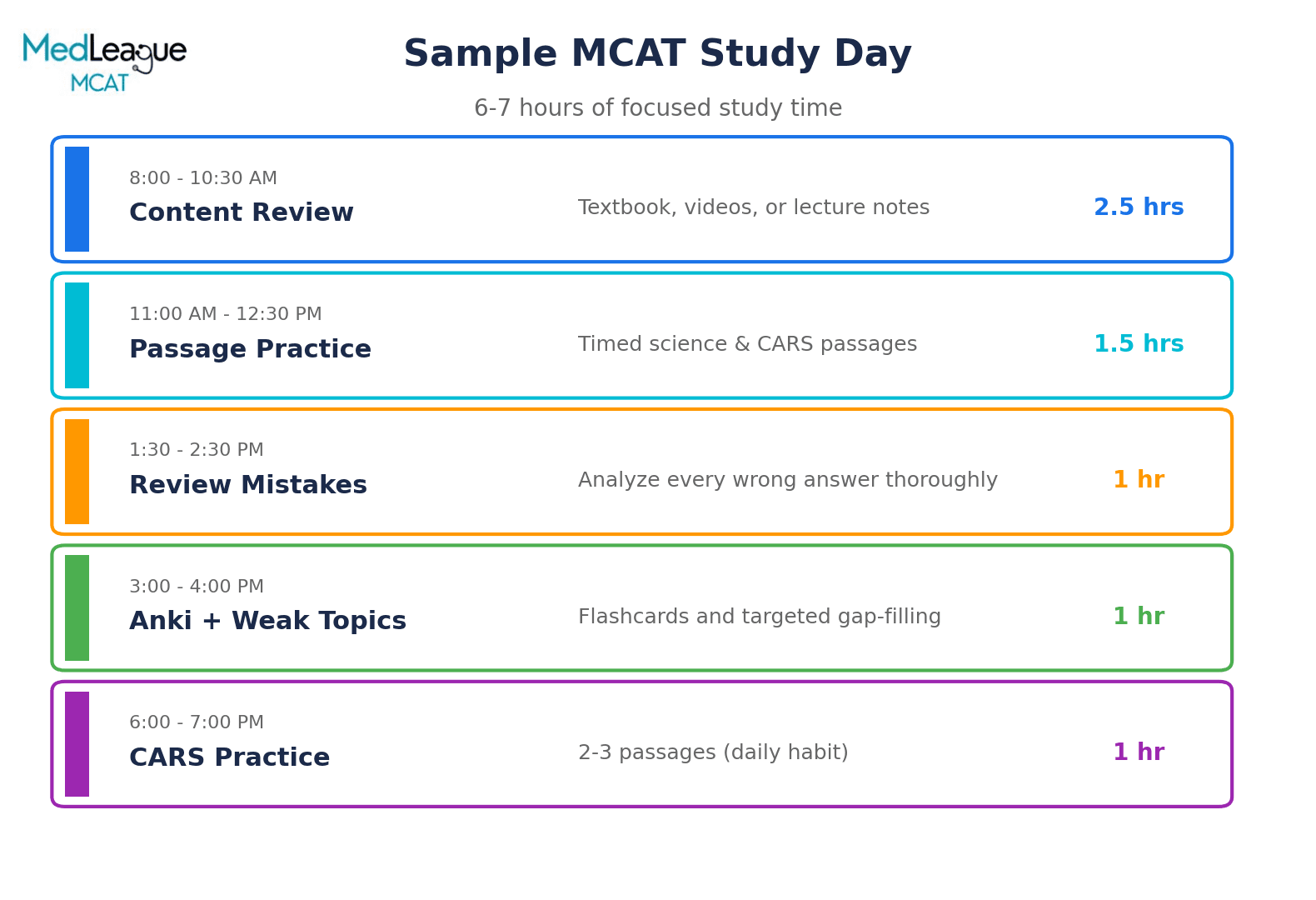
A sample week in the middle of your plan
A typical week in months 3–4 might look like this. Monday through Friday: 2 to 3 hours per day (e.g. 1 hour content review, 1 hour passage practice, 30 minutes mistake review). Saturday: 4 to 5 hours (a full-length or a long practice block plus review). Sunday: 1 to 2 hours (light review, flashcards, or catch-up). The important part is consistency. Same blocks each week so it becomes routine.
Get the full week-by-week plan
We put together a free 6-Month MCAT Study Plan with a week-by-week breakdown: what to study each week, how to split your hours, and when to schedule full-lengths. It's the same structure our instructors use with students. Enter your email below and we'll send you the PDF plus a short intro to MedLeague. No spam, just the plan and a few helpful emails.
(The download form appears below this post.)
Where MedLeague fits in
MedLeague's daily live workshops and thrice-weekly lessons follow this kind of arc. You get 99th percentile instructors, unlimited access to replays, and a 14-day free trial so you can try the structure before committing. If you'd rather have a ready-made timeline and live support instead of building it all yourself, that's what we're for.
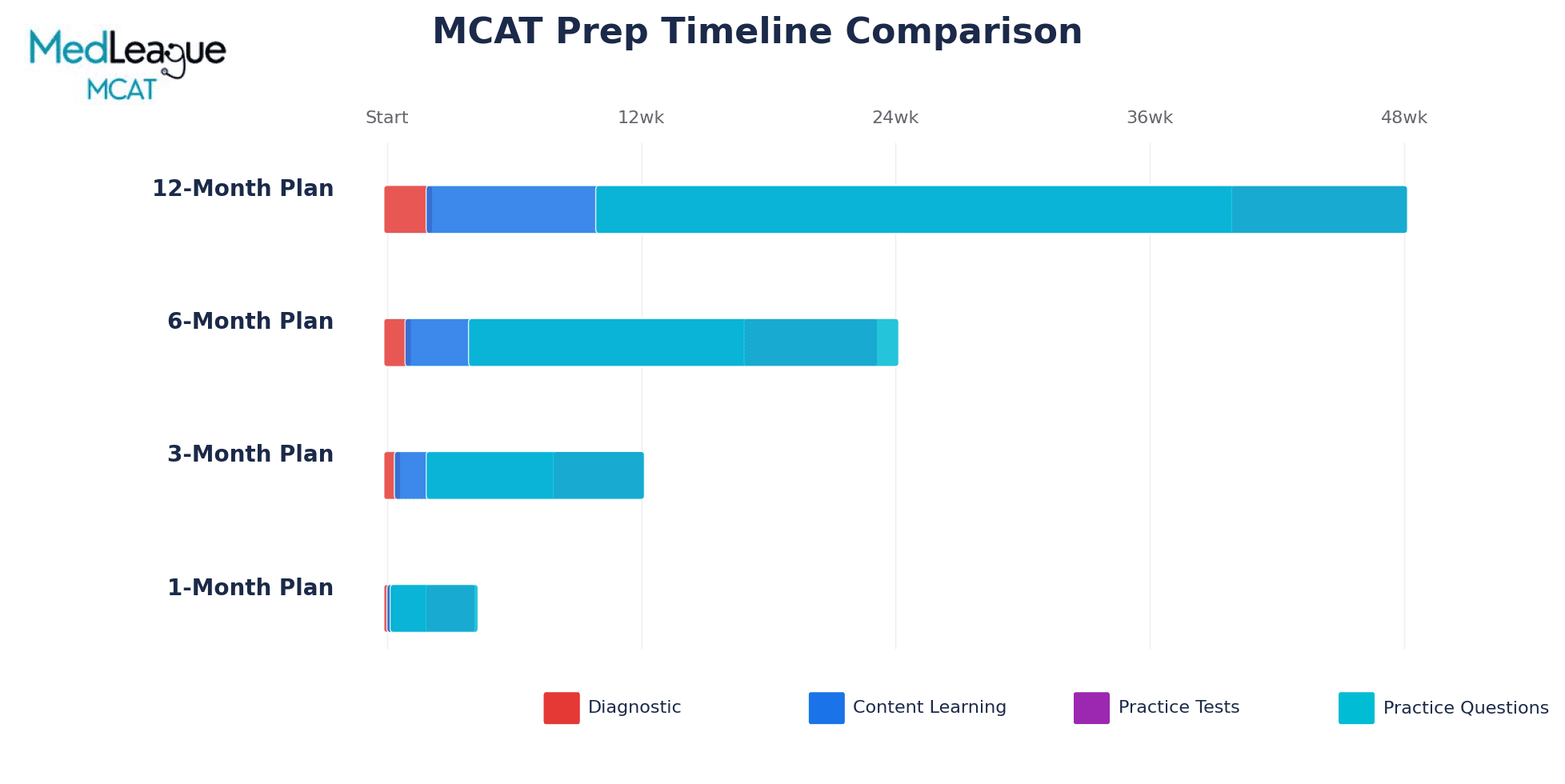
Stick to the 6-month rhythm: content, then practice, then full-lengths. Use the downloadable plan to fill in the week-by-week details. Adjust as you go, but keep the blocks consistent.
Written by the MedLeague MCAT team. Our instructors scored in the 99th percentile on the MCAT and have helped thousands of students improve their scores.