
Average MCAT Score: What It Means and Where You Stand
There are three different average MCAT scores and they tell very different stories. Learn which one matters for your application.
There are three different "average MCAT scores" and they tell very different stories. Most students only know one of them.
The Three Averages You Need to Know
When people say "average MCAT score," they could mean three different things. Each one represents a different group, and the gaps between them are significant.
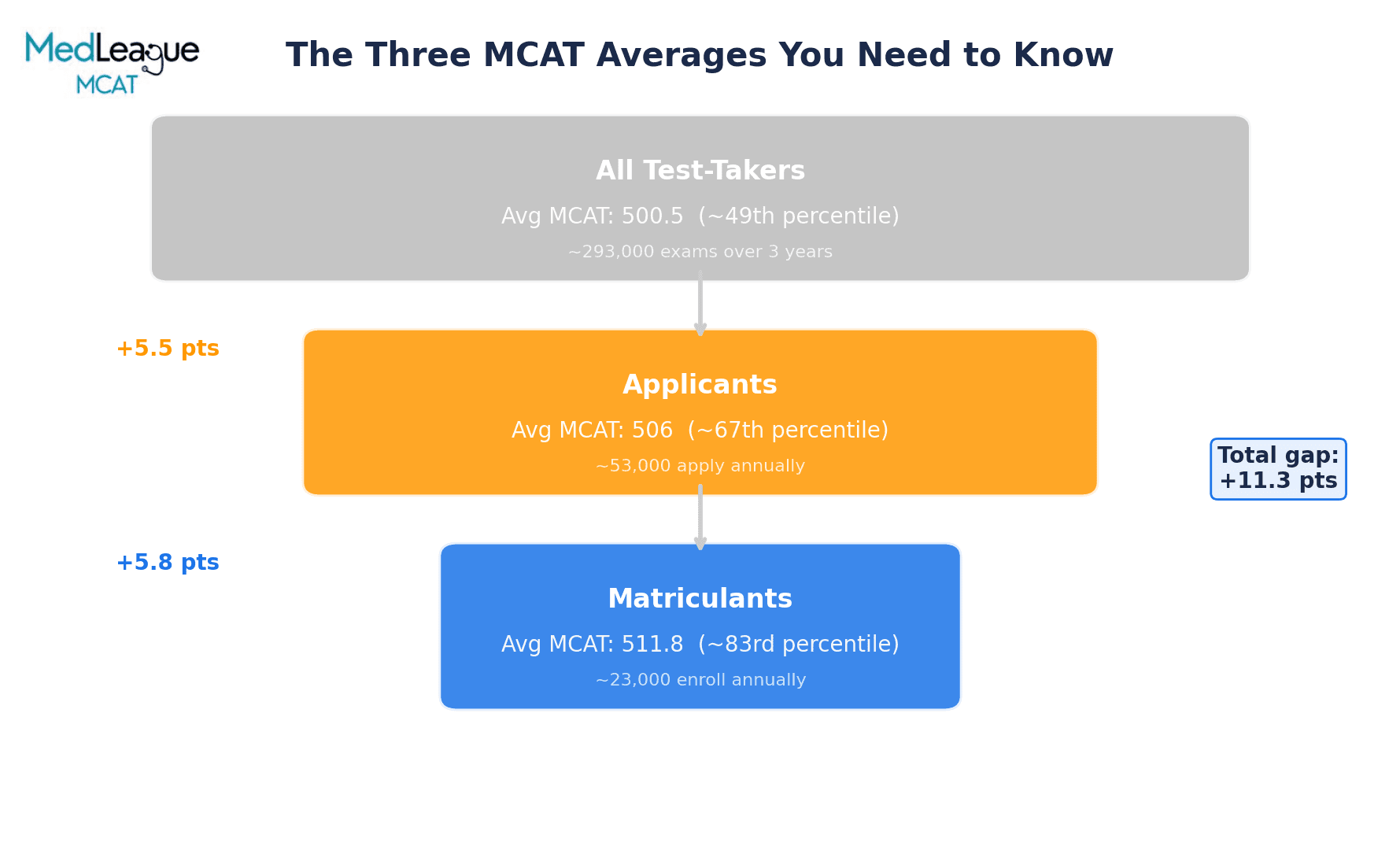
Average score for all test-takers: 500.5. This is the true statistical average across everyone who sits for the MCAT. It includes future matriculants, people who decide not to apply, and people who score poorly and retake later. It's the baseline, but it's not your target.
Average score for applicants: ~506. This filters out people who took the MCAT but never applied. The jump from 500.5 to 506 tells you something important: students who score below a certain threshold tend to self-select out of the process. If you're scoring around 506, you're average among people who actually applied.
Average score for matriculants: 511.8. This is the number that matters most. These are students who were accepted and enrolled in an MD-granting medical school. The gap between applicants (506) and matriculants (511.8) reflects how competitive the process really is. Getting in requires scoring roughly 6 points above the average applicant.
For DO programs, the average matriculant score is approximately 505, significantly lower than the MD average. This isn't because DO schools are "easier" in any meaningful sense. It reflects different admissions philosophies and a different applicant pool.
What the Average Means for Your Application
If you're at or above 512, you're above the average matriculant. Statistically, you're in strong territory for most MD programs.
If you're between 506 and 511, you're above the average applicant but below the average matriculant. You can get in, many students do, but your GPA and the rest of your application need to be strong.
If you're below 506, you're below the average applicant. This doesn't mean it's impossible, especially for DO programs, but it means you should seriously consider whether retaking with more preparation is the right move.
The key insight is that "average" isn't good enough if average means the test-taker average (500.5). You need to be above average, and specifically above the matriculant average, to be competitive.
Section Score Averages
The four MCAT sections have different average scores, which reflects differences in difficulty and how students tend to perform across subjects.
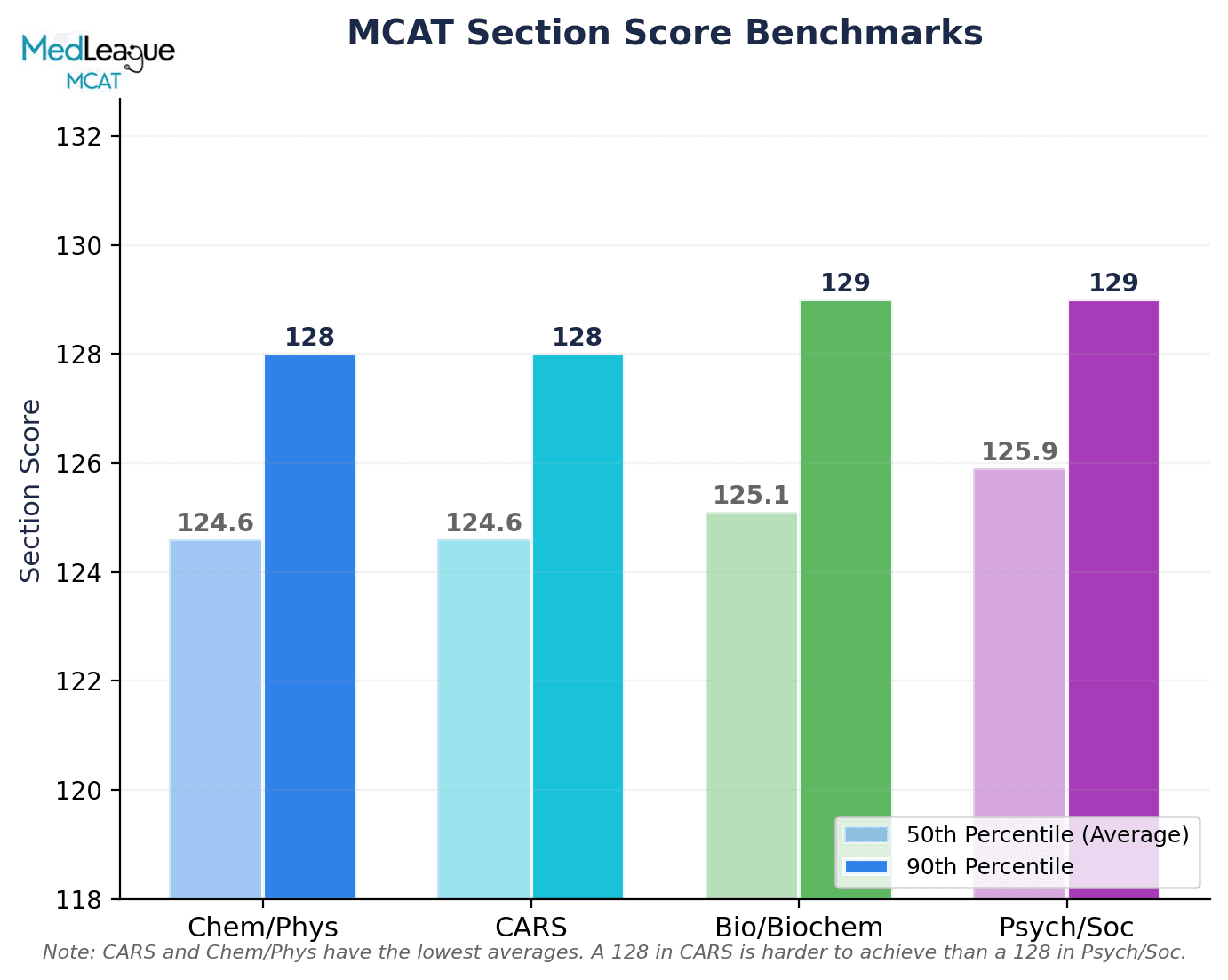
Chem/Phys has a mean of 124.6. This section combines general chemistry, organic chemistry, physics, and biochemistry. It tends to be challenging because of the breadth of content and the quantitative problem-solving required.
CARS has a mean of 124.6 as well, making it tied for the lowest section average. CARS is widely considered the most difficult section to improve because it's skill-based rather than content-based. It tests reading comprehension, critical analysis, and reasoning.
Bio/Biochem comes in at 125.1. This section tends to align well with what pre-med students have studied in their coursework, which is why it runs slightly higher than Chem/Phys.
Psych/Soc has the highest mean at 125.9. The content is more approachable for many students, and the section was added to the MCAT in 2015. The higher average means you need a higher section score to stand out. A 126 in Psych/Soc is less impressive than a 126 in CARS.
To reach the 90th percentile in any section, you need at least a 128-129. To hit the 75th percentile, you need approximately a 127. These benchmarks help you set section-level targets when building your study plan.
How Averages Have Changed Over Time
MCAT averages have been creeping upward over the past several years. The average matriculant score has moved from approximately 511.5 in 2020 to 511.8 in recent years. This isn't a huge shift, but it reflects a trend: more students are investing in structured prep, more students are retaking, and the applicant pool is getting more competitive.
The Psych/Soc section has seen the biggest average increase since it was introduced, rising by nearly a full point since 2015. Bio/Biochem has risen slightly as well. CARS and Chem/Phys have remained relatively stable.
What this means for you: a score that was "good enough" five years ago might be borderline today. When setting your target, use the most current matriculant data, not old benchmarks.
Scoring Above Average: What It Takes
The difference between scoring 500 (average test-taker) and 512 (above-average matriculant) comes down to two things: content mastery and test-taking strategy.
Content mastery is straightforward. You need to know the material tested across all four sections. This takes most students 300-500+ hours of study time, depending on their academic background.
Test-taking strategy is where most self-studiers fall short. The MCAT is a passage-based exam, and knowing the content isn't enough. You need to extract information from passages efficiently, eliminate wrong answer choices systematically, and manage your time across 230 questions. These are skills that improve with guided practice, not just more hours in a textbook.
MedLeague's daily workshops are built around this. You practice real MCAT-style passages with a 99th percentile instructor who walks you through exactly how top scorers approach each question type. It's the fastest way to close the gap between knowing the content and actually performing on test day.
If you're looking for a structured approach to get started, our free 6-Month MCAT Study Plan breaks down the timeline week by week, covering when to focus on content, when to shift to practice, and when to take full-length exams.
Where Do You Stand?
Take a practice test and find out. If your score is near 500, you have a clear path to improvement but it requires dedicated, structured preparation. If you're near 506, you're in the applicant average and need to push higher. If you're near 512 or above, you're in the matriculant range and your focus should shift to strategy refinement and section balance.
For a breakdown of what every specific score range means for your chances, read our score-by-score MCAT breakdown. To understand what your percentile really means, check out our guide to interpreting your MCAT percentile.
Or, if you want personalized advice on your score, your school list, and your study plan, book a free strategy session. You'll also receive a free AAMC Full Length Exam ($40 value) when you show up.