
Best MCAT Prep Courses in 2026: Honest Rankings
Best MCAT prep courses in 2026: honest rankings and comparisons. Learn what separates a great course from a flashy marketing page.
Best MCAT Prep Courses in 2026: Honest Rankings
Choosing an MCAT prep course is one of the most consequential decisions you'll make as a premed. The wrong choice wastes months and thousands of dollars. The right one can mean the difference between a 510 and a 520.
I've spent years teaching MCAT content, talking to students about what worked, and watching the prep industry shift. This ranking reflects what actually matters: instructor quality, practice material depth, flexibility, and whether students consistently hit their target scores. No sponsorship deals influenced these rankings, and I'll be straightforward about each option's weaknesses.
What Makes an MCAT Prep Course Actually Good
Before diving into specific courses, here's what separates effective prep from expensive noise.
Instructor expertise. The person teaching you enzyme kinetics or CARS reasoning should have scored in the 99th percentile themselves and have real teaching experience. A high score alone doesn't make someone a good teacher. You want both.
Quality practice materials. This means full-length exams that mimic AAMC logic, not just thousands of random questions. The best courses teach you how the MCAT thinks, not just how to memorize content.
Flexibility and structure balance. Some students need a rigid schedule. Others need to fit prep around organic chemistry and volunteering. The best courses give you structure without locking you into a one-size-fits-all timeline.
Access to help when you're stuck. This is where most courses fail. Pre-recorded videos are fine until you hit a concept you genuinely don't understand. Then you need a real person who can answer your specific question.
The Rankings
1. Blueprint MCAT (Formerly Next Step)
Blueprint has earned its reputation. Their full-length practice exams are among the best third-party options available, and their adaptive learning technology has improved significantly in recent years. The platform adjusts to your weak areas and serves content accordingly.
Strengths:
- 15+ full-length practice exams with detailed explanations
- Strong adaptive study planner
- Engaging video content with good production quality
- Solid CARS practice passages
Weaknesses:
- Live instruction class sizes can be large, making it hard to ask individual questions
- The highest-tier packages get expensive fast
- Some students report that the adaptive algorithm occasionally misjudges readiness
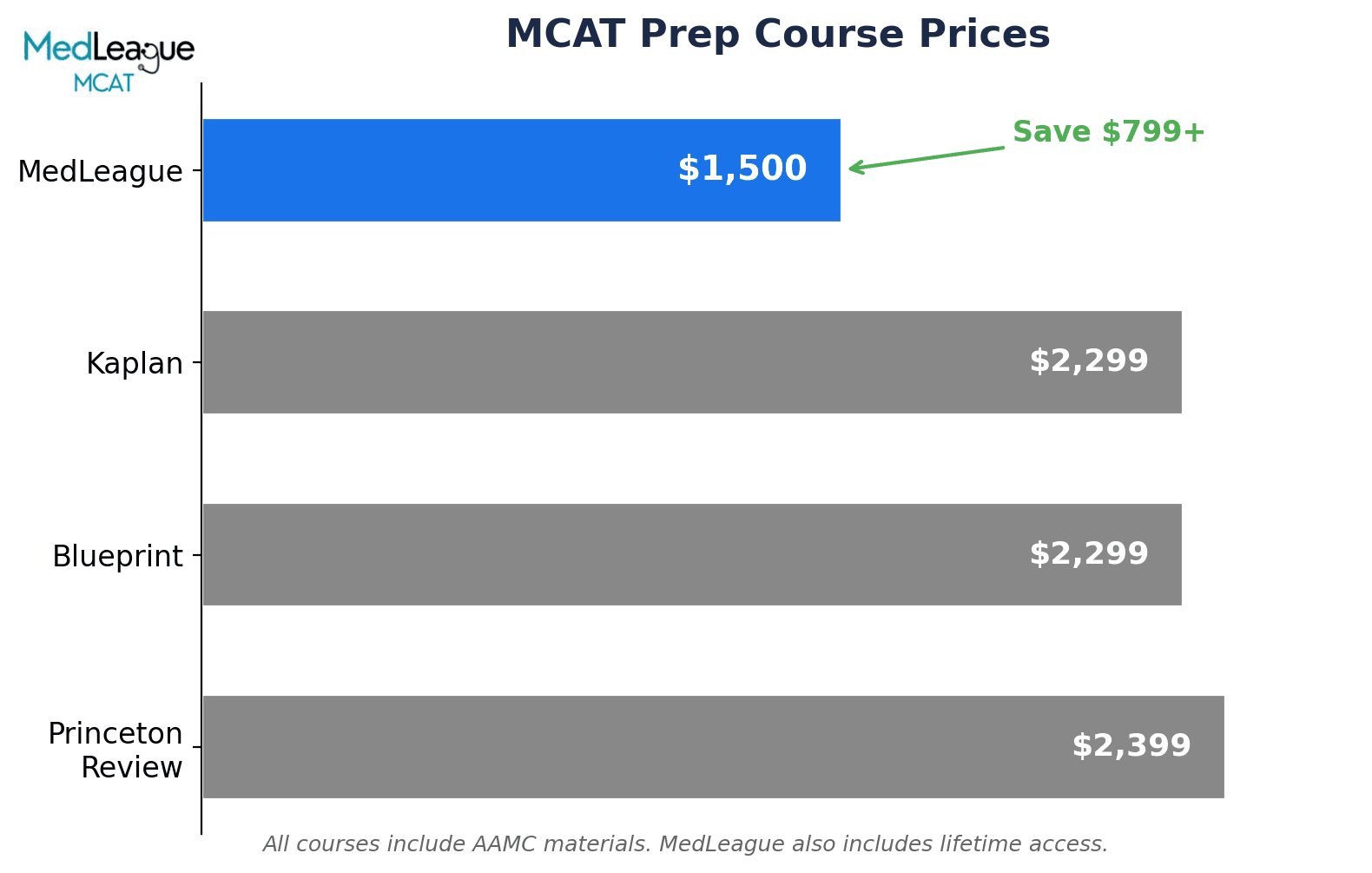
Blueprint works best for self-motivated students who thrive with technology-driven learning. If you like data dashboards and watching your metrics improve, you'll enjoy this platform. Pricing ranges from roughly $1,700 to $3,500 depending on the package.
2. MedLeague
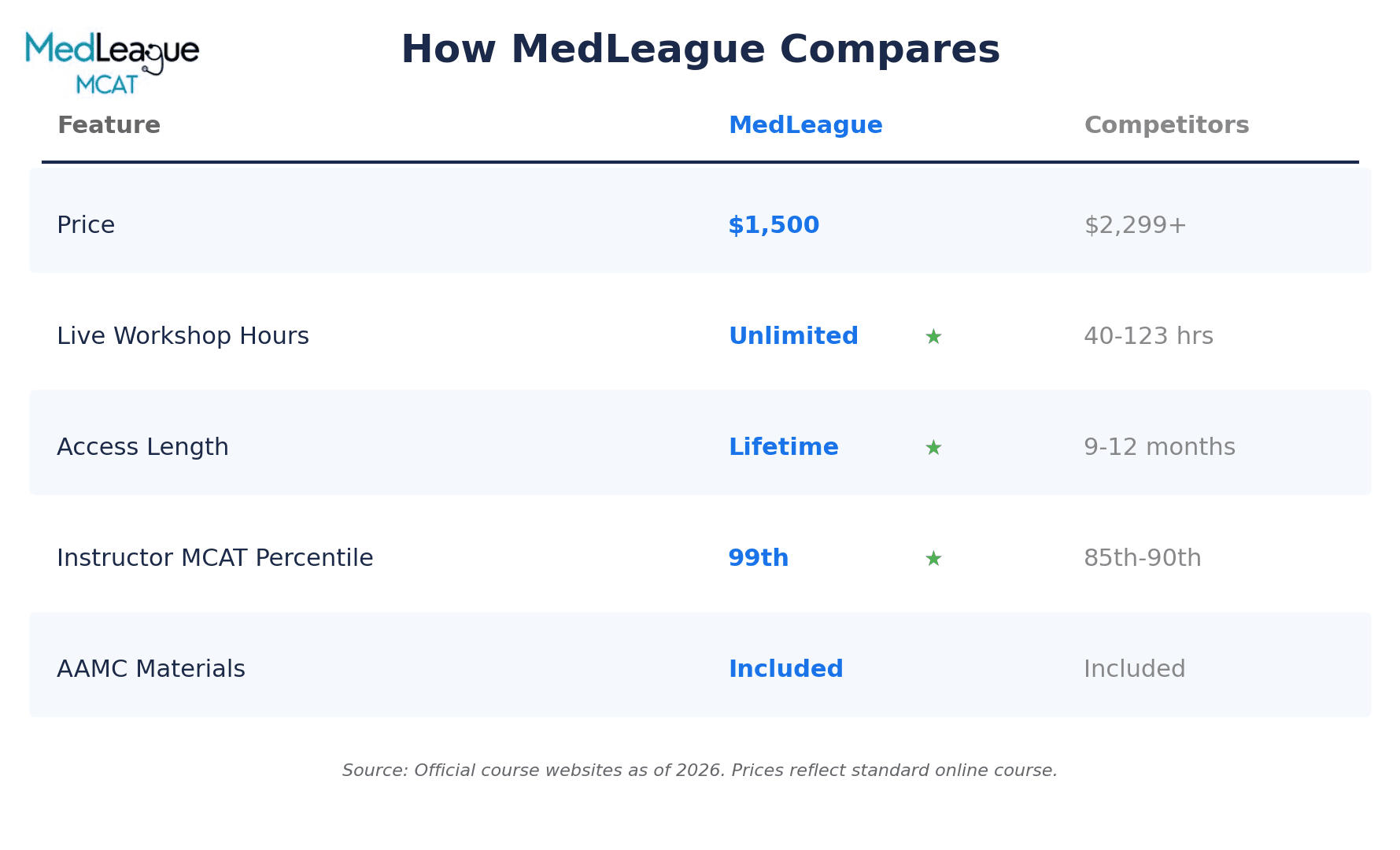
MedLeague takes a different approach from the big-box prep companies. Their model centers on live instruction from 99th percentile scorers, with unlimited access to both live workshops and replays. That "unlimited" piece matters more than it sounds. Most companies cap your live sessions or charge extra for additional help.
Strengths:
- All instructors scored in the 99th percentile
- Unlimited live workshops and full replay library
- 14-day free trial so you can actually test the experience before paying
- Smaller, more interactive sessions compared to large lecture-style classes
Weaknesses:
- Smaller company, so the brand recognition isn't at the level of Blueprint or Kaplan yet
- Fewer proprietary full-length exams (though they pair well with AAMC materials)
What stands out about MedLeague is the instructor access. You can attend as many live sessions as you want, go back and rewatch anything, and get questions answered in real time. For students who learn best through interaction rather than passive video watching, this is a strong fit. The free trial also removes the financial risk of committing to a course that might not match your learning style.
3. Kaplan MCAT
Kaplan is the legacy name in test prep. They have decades of infrastructure, a massive question bank, and name recognition that gives some students peace of mind. Their books remain a solid content review foundation that many students use regardless of which course they're enrolled in.
Strengths:
- Comprehensive content review books (the 7-book set is a premed staple)
- Large question bank with good explanations
- Structured study plans for different timelines
- Wide availability of in-person and online options
Weaknesses:
- Instructor quality varies significantly. Some are excellent. Others are reading from scripts.
- The course can feel rigid and lecture-heavy
- Premium pricing ($2,500 to $3,500+) without proportionally premium results
- Full-length exams don't always reflect current AAMC scoring patterns accurately
Kaplan is a safe choice, but "safe" doesn't always mean "best." If you're someone who wants a clear, structured path and doesn't mind a traditional classroom feel, Kaplan delivers. But if you need personalized attention or flexible pacing, you may find it frustrating.
4. Jack Westin
Jack Westin started as a CARS-focused resource and has expanded into a broader MCAT prep platform. Their free CARS practice passages remain some of the best available anywhere, and their daily passage practice has built a loyal following.
Strengths:
- Excellent CARS resources, much of it free
- Growing library of science content
- Active online community and study groups
- Very affordable compared to full-service courses
Weaknesses:
- Science content isn't as deep or polished as competitors
- Limited full-length exam options
- The platform still feels like it's growing into a full prep course rather than being one already
Jack Westin is ideal as a supplement, especially for CARS. If CARS is your weakest section, their daily practice is genuinely helpful. As a standalone prep course for all four sections, it's not quite there yet. But at its price point, it offers real value.
5. Princeton Review MCAT
Princeton Review offers a premium experience with a money-back guarantee if your score doesn't improve. That guarantee gets a lot of attention in marketing, but read the fine print. You need to complete every assignment and meet specific criteria to qualify.
Strengths:
- Score improvement guarantee (with conditions)
- Solid video content library
- Good number of practice tests
- Options for both self-paced and live instruction
Weaknesses:
- One of the most expensive options ($2,000 to $3,500+)
- Instructor quality is inconsistent across locations and sections
- Some students find the platform interface clunky
- The guarantee conditions are strict enough that many students don't qualify
Princeton Review works for students who want external accountability and are willing to invest at the top of the price range. The guarantee sounds reassuring, but your focus should be on whether the teaching actually works, not on getting a refund.
6. Altius MCAT
Altius uses a small-group tutoring model that sits between a traditional course and private tutoring. Groups are typically 4 to 8 students, which means more personal attention than a 30-person lecture but at a lower price than one-on-one tutoring.
Strengths:
- Small group sizes with consistent instructor relationships
- Personalized feedback on practice exams
- Strong emphasis on test-taking strategy, not just content
Weaknesses:
- Expensive, often $4,000+
- Limited scheduling flexibility since groups meet at set times
- Smaller content library compared to larger competitors
If budget isn't your primary concern and you know you learn best with close instructor guidance, Altius is worth considering. The small group format creates accountability that self-paced courses can't match.
Free and Low-Cost Resources Worth Using
Regardless of which course you choose, these free resources should be part of your prep.
- AAMC materials. Non-negotiable. The official AAMC full-length exams, section banks, and question packs are the closest thing to the real test. Buy them all.
- Anki decks. The MileDown and Jacksparrow2048 decks cover high-yield content effectively. Use them daily for retention.
- Khan Academy MCAT collection. Free video content that covers most foundational topics. Not enough on its own, but a helpful supplement.
- UPangea (formerly UWorld). Their question bank has some of the best discrete and passage-based practice questions available. The explanations teach you how to think through problems.
How to Choose the Right Course for You
Your ideal course depends on three things: how you learn, how much time you have, and what you can afford.
If you're a self-directed learner who just needs materials and a plan, Blueprint's adaptive platform or a combination of AAMC materials plus UPangea might be enough.
If you learn best through live interaction and want to ask questions in real time, look at courses with strong live components. MedLeague's unlimited workshop model or Altius's small groups fit this profile well.
If you want maximum structure and don't mind a traditional approach, Kaplan or Princeton Review will give you a clear schedule and a known path.
If you're on a tight budget, combine Jack Westin's free CARS resources with Khan Academy videos, Anki for content review, and official AAMC materials. This stack costs under $300 and can absolutely produce competitive scores if you're disciplined.
Common Mistakes When Picking a Prep Course
Choosing based on brand name alone. Kaplan and Princeton Review have the biggest marketing budgets. That doesn't mean they have the best instructors or the best outcomes for your learning style.
Ignoring instructor access. A library of 500 videos means nothing if you can't get help when you're stuck on passage-based reasoning in biochemistry at 10 PM on a Tuesday. Prioritize courses that let you interact with instructors.
Buying the most expensive option and assuming it's the best. Price and quality don't correlate as neatly as companies want you to believe. A $2,000 course with mediocre instructors will lose to a $500 resource stack used consistently by a focused student.
Starting a course without a baseline score. Take a diagnostic full-length before you commit to anything. Your starting score determines how much content review you need and which course intensity makes sense.
Get Personalized Help Choosing Your Course
Comparing options is smart, but the best course for you depends on your starting score, timeline, learning style, and budget. Book a free strategy session with an MCAT expert and get a free AAMC Full Length Exam ($40 value). The session is personalized—we'll look at your timeline, your score goals, and the best next step for you.
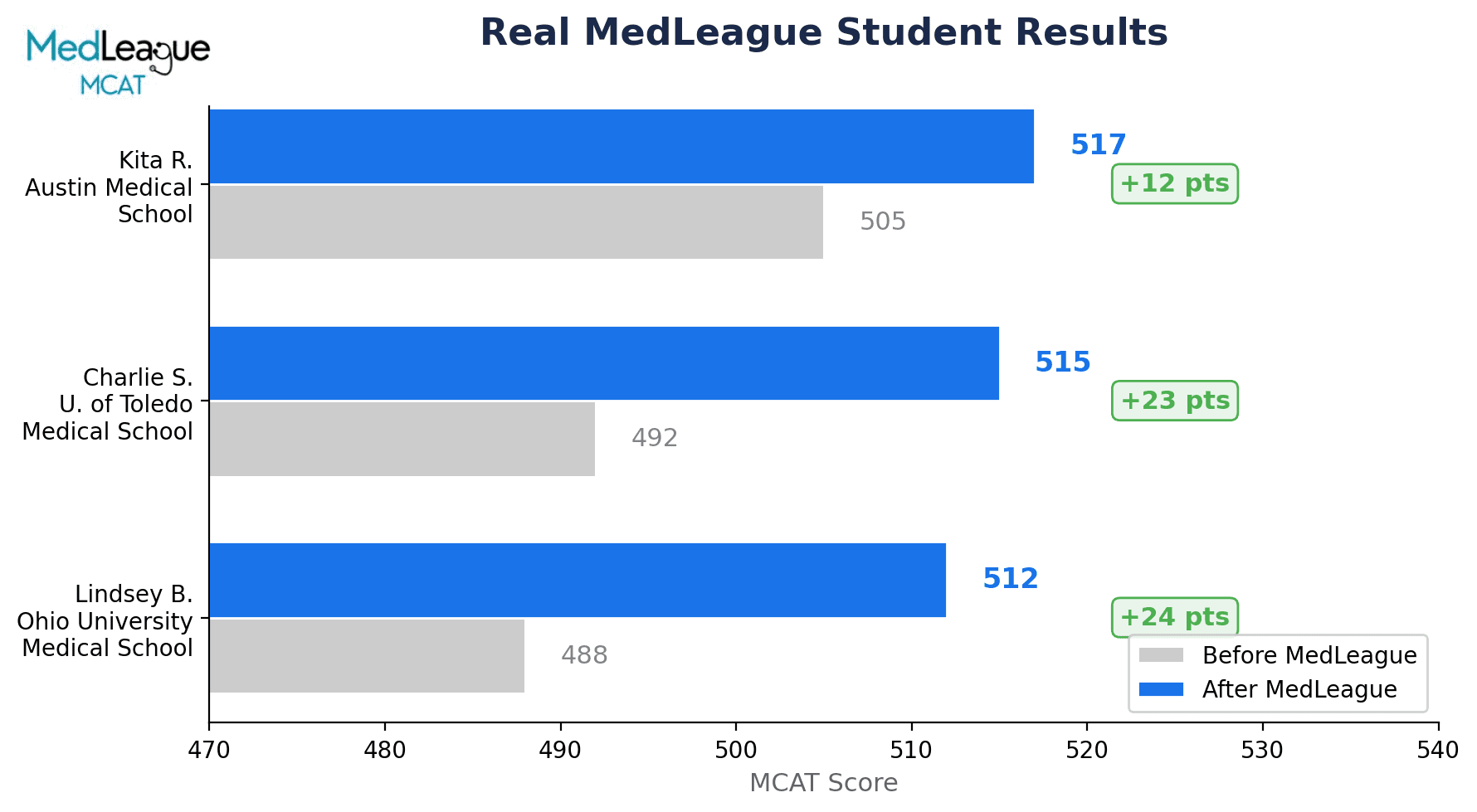
This is the same kind of session that helps students like Kita (505 → 517) and Charlie (492 → 515) get unstuck and build a plan that actually works.
Final Thought
The best MCAT prep course is the one you'll actually use consistently for three to six months. Fancy platforms and big promises mean nothing if the teaching style doesn't click with how your brain works. Take advantage of free trials, watch sample lectures, and talk to students who've used the courses you're considering. Your prep investment, both time and money, is too significant to decide based on a ranking list alone. Including this one.
Written by the MedLeague MCAT team. Our instructors scored in the 99th percentile on the MCAT and have helped thousands of students improve their scores.