
Is My MCAT Score Good Enough? A Score-by-Score Breakdown
Find your exact MCAT score range and learn what it means for medical school admissions. Covers every bracket from below 500 through 520+ with honest next steps.
Whether you just got a practice test result or your actual score back, this guide tells you exactly where you stand and what to do about it.
How to Use This Guide
Find the score range that matches your MCAT score (or practice test score). Each section tells you what percentile you're in, what types of programs you're competitive for, and the honest next steps. We've based all of this on AAMC data, real admissions outcomes, and the experience of helping thousands of students improve their scores.
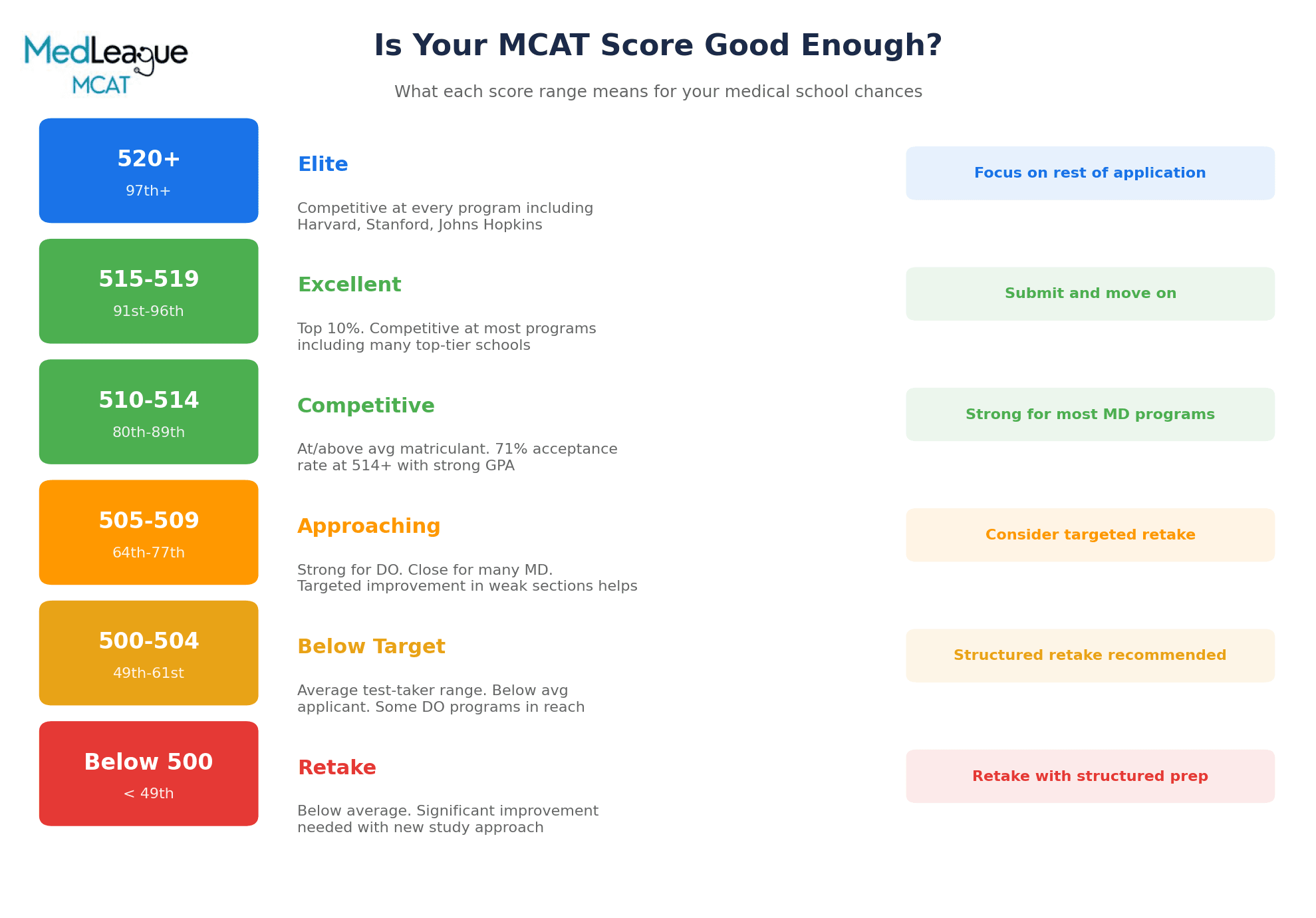
Below 500 (Below the 49th Percentile)
The reality: You're below the average test-taker, and significantly below the average medical school matriculant (511.8). At this score, most MD programs are out of reach, and even DO programs (average matriculant ~505) will be a stretch.
What this usually means: There are likely significant content gaps, test-taking strategy issues, or both. Many students who score in this range were either underprepared or struggled with time management and test anxiety on exam day.
What to do: If this was a practice test, it's a clear signal that you need more preparation time before sitting for the real thing. If this was the actual exam, consider retaking, but only after a fundamental change in your study approach. More of the same won't produce different results. A structured prep program with expert guidance is the most reliable way to close a gap this large.
The good news: Large score improvements are common with the right preparation. MedLeague student Lindsey Baker went from 488 to 512, a 24-point jump. That kind of improvement takes work, but it's achievable.
500-504 (49th to 61st Percentile)
The reality: You're around the average test-taker, which means you're below the average medical school applicant (506) and well below the average matriculant. Some DO programs are within reach, but MD programs will be challenging at this score.
What this usually means: You likely have a reasonable content foundation but gaps in specific areas, and your test-taking strategy probably has room for improvement. The difference between a 502 and a 512 is often more about passage analysis skills and timing than raw content knowledge.
Where you're competitive: Some DO programs, particularly those with average matriculant scores in the 502-506 range. If your GPA is strong (3.6+) and you have compelling clinical experience, a few less competitive MD programs might consider your application.
What to do: You have two paths. If you're applying to DO programs and your GPA is strong, this score can work. If you're targeting MD programs, a retake with structured preparation is the move. Focus your retake prep on passage-based strategy, not just content review.
505-509 (64th to 77th Percentile)
The reality: You're above the average test-taker and approaching the average applicant. At the top of this range (508-509), you're getting close to competitive territory for many MD programs. At the bottom (505), you're strong for DO and borderline for MD.
What this usually means: Your content knowledge is solid but not complete, and there's likely a weak section dragging your score down. Look at your section breakdown. One or two sections probably have clear room for improvement.
Where you're competitive: Strong for nearly all DO programs. At 508+, you're competitive at many state medical schools, especially if you're an in-state applicant with a strong GPA. Some mid-tier MD programs are in play.
What to do: This is the range where targeted improvement can make the biggest difference. You don't need to overhaul your entire approach. You need to identify your weakest section and focus there. Going from a 505 to a 512 might only require fixing one section, which is much more manageable than a full retake plan.
510-514 (80th to 89th Percentile)
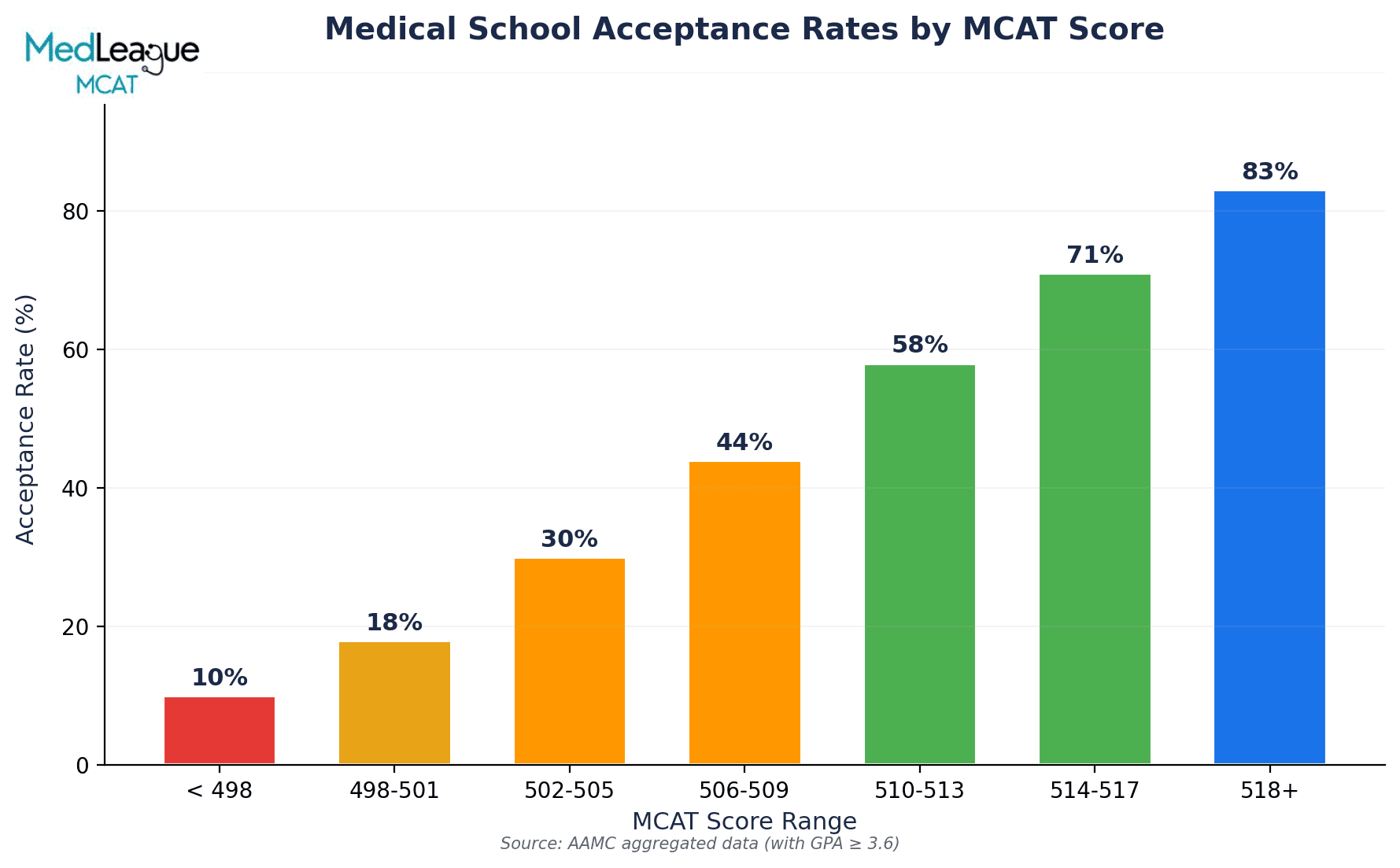
The reality: You're at or above the average matriculant. This is a legitimately good score. You're competitive at most MD programs and very strong at DO programs. AAMC data shows that students with a 514+ and a GPA of 3.6+ have about a 71% acceptance rate.
What this usually means: You have solid content knowledge, decent passage analysis skills, and reasonably good time management. The remaining improvement potential is usually in strategy refinement and section balance.
Where you're competitive: Most MD programs, including many well-regarded state schools and mid-ranked private programs. At 514, you're starting to be competitive at some higher-ranked programs as well. Essentially every DO program.
What to do: If you're applying broadly to MD programs, this score works. Focus your energy on the rest of your application: personal statement, extracurriculars, and school list. If you're targeting top-20 programs specifically, you may want to consider retaking to push into the 515+ range, but only if you're confident you can improve. A retake that doesn't improve your score (or drops it) looks worse than a solid 512.
For context: MedLeague student Lindsey Baker scored a 512 and was accepted to Ohio University Medical School. Charlie Steweard scored 515 and got into the University of Toledo Medical School. These scores open real doors.
515-519 (91st to 96th Percentile)
The reality: This is an excellent score. You're in the top 10% of all MCAT test-takers. You're competitive at the vast majority of medical schools in the country, including many top-ranked programs.
What this usually means: Strong content mastery across all four sections, solid test-taking strategy, and good time management. Students in this range typically have no major content gaps and can focus on polishing their applications rather than worrying about their MCAT.
Where you're competitive: Nearly every MD program, including many top-20 schools. At 518-519, you're in range for the most selective programs in the country, provided the rest of your application is strong. AAMC data indicates that very few students with a 517+ and a strong GPA are rejected outright.
What to do: Do not retake unless you have very specific circumstances (like a section score of 124 or below that some schools may flag). A 515+ is a score you submit and move on from. Spend your time on secondary essays, interview preparation, and building the strongest possible school list.
520+ (97th Percentile and Above)
The reality: You're in the top 3% of all MCAT test-takers. This score makes you competitive at every medical school, including Harvard, Stanford, Johns Hopkins, UCSF, and Washington University. Only an estimated 30-70 test-takers per year achieve the maximum score of 528.
What this usually means: Exceptional content knowledge, strong analytical skills, and excellent test-day execution. Students at this level typically invested significant time in structured preparation.
Where you're competitive: Everywhere. Every MD program. Every DO program. Every MD/PhD program. The MCAT is no longer the limiting factor in your application.
What to do: Absolutely do not retake. Focus entirely on the rest of your application. At this score, admissions decisions come down to research experience, clinical exposure, personal statement, school fit, and interview performance. Make sure the rest of your application matches the caliber of your MCAT score.
What If You're Between Ranges?
If you're right on the border (say, a 509 when "competitive" starts at 510), don't panic. A one-point difference rarely changes an admissions outcome. Schools look at score ranges, not exact cutoffs. A 509 and a 511 are, functionally, evaluated very similarly.
Where exact numbers matter more is when schools use automated screening. Some programs filter out applications below a certain MCAT threshold before a human ever sees them. These thresholds vary by school and aren't always published, but scoring above 510 puts you above most of them.
The Bigger Picture: Your Score Is a Starting Point
Wherever you scored, remember that the MCAT is one piece of a larger application. A perfect score can't compensate for a weak application, and a slightly-below-target score doesn't mean rejection if everything else is strong.
The students who succeed aren't necessarily the ones who score the highest. They're the ones who understand where they stand, make a plan, and execute it. Whether that means building a school list around a 510 or pushing for a retake to break 515, the key is clarity about your situation and a realistic strategy.
If you're still in the preparation phase and want a structured approach, download our free 6-Month MCAT Study Plan. It gives you a week-by-week framework for content review, practice tests, and targeted practice.
And if you want a 99th percentile MCAT expert to look at your score, your GPA, and your school list and tell you exactly what to do next, book a free strategy session. You'll get a free AAMC Full Length Exam ($40 value) just for showing up.
Related reading: How to interpret your MCAT percentile | What is a good MCAT score? | What is a good MCAT percentile? | Average MCAT score explained