
What is a Good MCAT Percentile?
Find out what MCAT percentile you need for medical school. Concrete benchmarks broken down by DO programs, mid-tier MD, top 20, and elite programs.
The short answer: it depends on where you want to go to school. The longer answer is more useful.
The Quick Benchmarks
If you're looking for a one-line answer: an MCAT percentile of 80th or above (around a 510+) makes you competitive at many medical schools. A percentile of 90th or above (around 515+) makes you competitive at most, including many top-tier programs.
But "good" is relative. A 70th percentile might be excellent for some applicants and disappointing for others, depending on their school list, GPA, and the rest of their application. So let's break this down by what you're actually trying to accomplish.
Percentile Ranges and What They Mean for Admissions
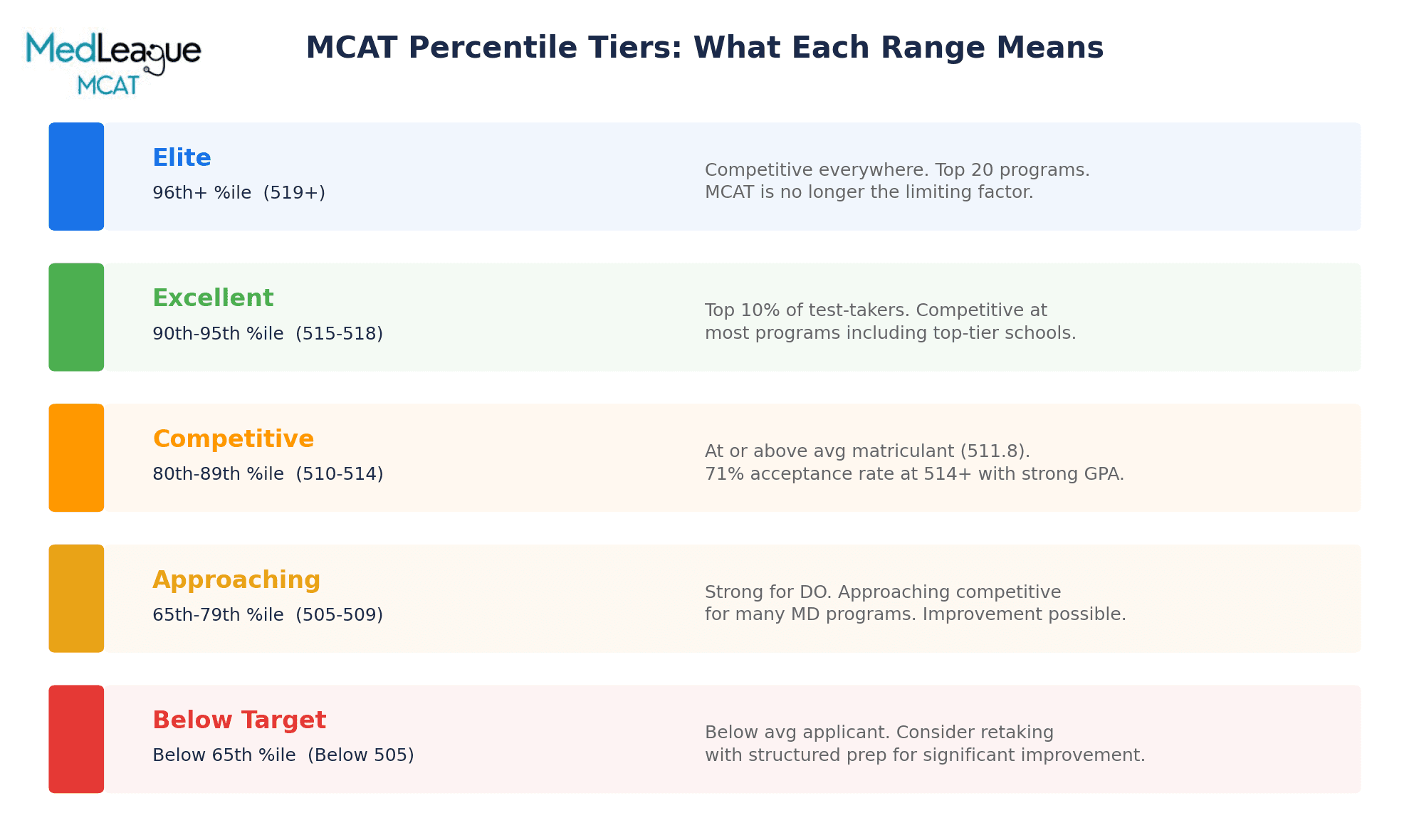
Below the 50th percentile (below 500): This is below average for all test-takers and significantly below the average matriculant. If this is your score, most admissions counselors would recommend retaking the exam. Some DO programs accept scores in this range, but your options are limited.
50th to 69th percentile (500-507): You're above the average test-taker but below the average medical school matriculant. These scores can work for less competitive MD programs and are solid for many DO programs (where the average matriculant scores around 505). Pair this with a strong GPA and application, and doors are still open.
70th to 79th percentile (508-510): Now you're getting close to the average matriculant range. A score here makes you competitive at a good number of MD programs, especially if your GPA is strong and the rest of your application is well-rounded. You're in solid shape for DO programs.
80th to 89th percentile (510-514): This is the sweet spot. The average MD matriculant scores a 511.8, so you're right in that range. A score here makes you competitive at most MD programs outside the top 20. AAMC data shows that students with a 514+ and a strong GPA have about a 71% acceptance rate.
90th to 95th percentile (515-518): You're in the top 10% of all test-takers. This opens doors at competitive and top-tier programs. A 515 specifically is the 91st percentile and is widely considered the threshold for "excellent."
96th percentile and above (519+): You're in elite territory. Scores in this range make you competitive at the most selective programs in the country, including schools like Harvard, Johns Hopkins, and Stanford, where the median accepted MCAT is often 520+.
Why the "Average Matriculant" Number Is Your Best Benchmark
You'll see a lot of numbers thrown around when researching MCAT scores. The one that matters most is the average matriculant score: 511.8 for MD programs (approximately the 83rd percentile).
This is the average score of students who actually got accepted and enrolled in medical school. Not the average test-taker. Not the average applicant. The average person who made it in.
Scoring at or above the 80th percentile means you're in the range where acceptance becomes statistically likely, assuming the rest of your application is strong. Scoring below it doesn't mean you can't get in, but it does mean you'll need other parts of your application to compensate.
For DO programs, the benchmark is lower. The average DO matriculant scores around 505 (roughly the 64th percentile). If osteopathic medicine is your path, a 65th percentile or higher puts you in a solid position.
Your Percentile Isn't the Whole Picture
A strong MCAT percentile opens doors, but admissions committees evaluate applicants holistically. Your GPA, clinical experience, research, personal statement, and letters of recommendation all factor in. A student with a 75th percentile MCAT and an incredible personal story can beat a student with a 95th percentile score and a thin application.
That said, the MCAT is often called the "great equalizer" in medical school admissions. It's the one standardized measure that lets schools compare applicants from different colleges, different grading systems, and different academic backgrounds. So while it's not everything, it carries serious weight.
How to Improve Your Percentile
The good news about the MCAT is that it's learnable. Unlike something like the SAT, which many students take with minimal preparation, the MCAT rewards structured studying over months. That's why the gap between casual self-study and structured prep is so significant.
MedLeague students average a 17+ point score improvement, which translates to roughly a 20-30 percentile jump. The difference between a 495 (30th percentile) and a 512 (85th percentile) is the difference between being below average and being above the typical matriculant.
If your current percentile isn't where it needs to be, the most important step is getting a structured study plan that targets your specific weaknesses. We put together a free 6-Month MCAT Study Plan that breaks your prep into weekly targets across content review, practice tests, and strategy development.
What Percentile Should YOU Target?
Start by researching the schools you want to attend. Look up their median MCAT score in the AAMC's MSAR database, then aim for a percentile that puts you at or above that median. Add 2-3 points as a buffer, because you want to be competitive, not borderline.
If you're not sure where to start, or if you want a personalized assessment of where your score stacks up against your target schools, book a free strategy session with a MedLeague MCAT expert. You'll walk away with a customized plan and a free AAMC Full Length Exam ($40 value).
Related reading: How to interpret your MCAT percentile | What is a good MCAT score? | MCAT score-by-score breakdown