
What is a Good MCAT Score?
A good MCAT score is 510+, competitive is 512+, excellent is 515+. Data-backed benchmarks by school type and what they mean for your application.
Medical school admissions committees won't tell you their cutoff. But the data tells a clear story.
The Direct Answer
A good MCAT score is 510 or above. A competitive score is 512 or above. An excellent score is 515 or above. These aren't arbitrary numbers. They come directly from admissions data.
The average MCAT score for medical school matriculants (students who were accepted and enrolled) is 511.8. That's the number you're competing against. Score above it, and you're in a strong position at most programs. Score well above it, and top-tier schools come into play. Score below it, and you'll need other parts of your application to make up the difference.
But "good" really depends on where you're applying. Let's break it down.
Good Scores by School Type
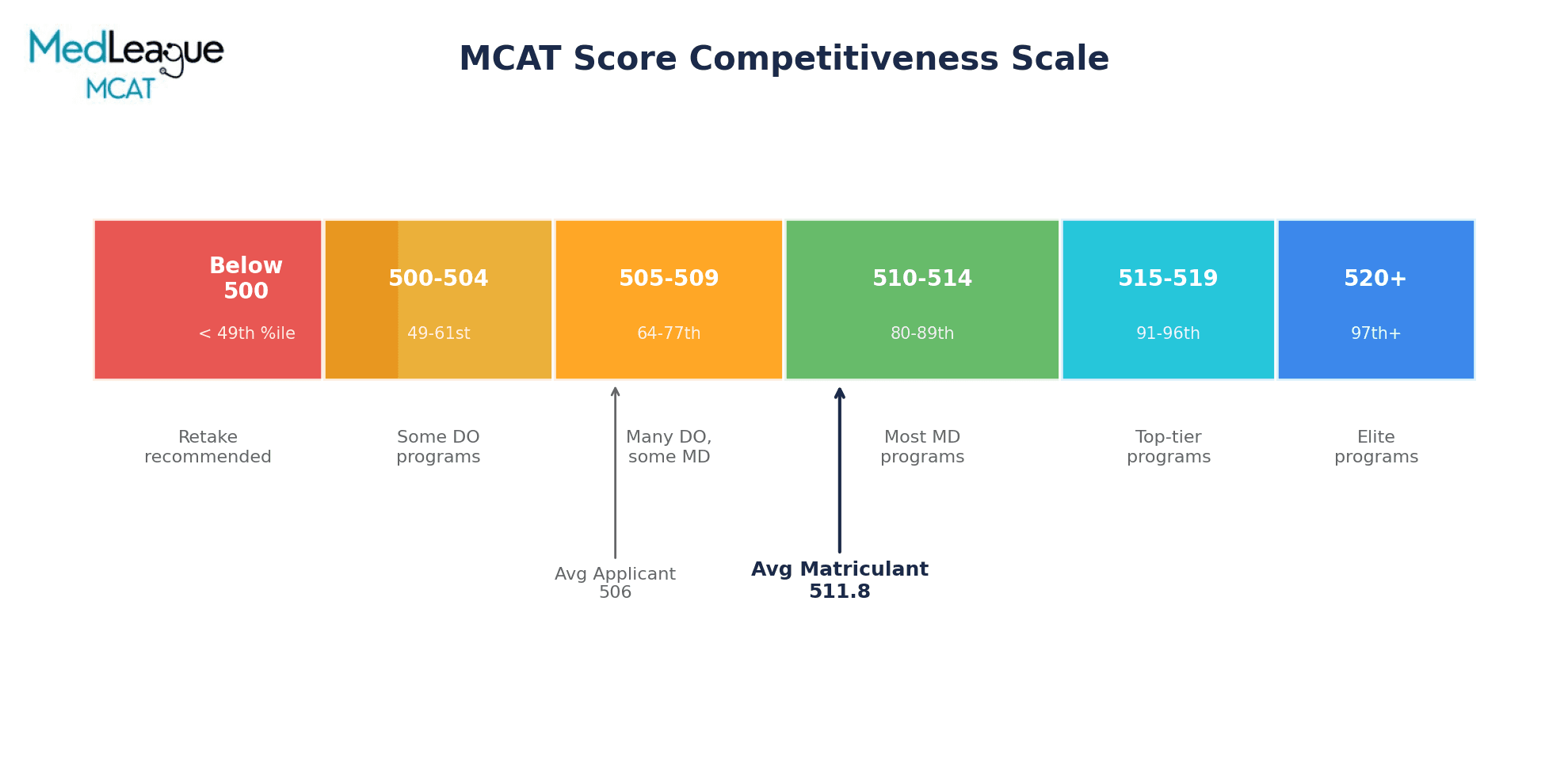
DO Programs (Osteopathic Medicine): The average DO matriculant scores around 505. A score of 504-508 makes you competitive at most DO programs. If you score 510+, you're well above average for the DO applicant pool.
Mid-Tier MD Programs: Most state medical schools and mid-ranked programs have average accepted MCAT scores between 509 and 514. A 510-514 puts you squarely in range. Your GPA, state residency, and extracurriculars will determine whether you're above or below the line.
Competitive MD Programs: Programs ranked roughly in the top 30-50 typically see average matriculant scores of 515-519. You need a 515+ to be competitive here, and even then, strong extracurriculars and research experience matter significantly.
Top 20 MD Programs: Harvard, Stanford, Johns Hopkins, UCSF, and similar programs see median MCAT scores of 520+. To be competitive, you're looking at 518+ at minimum, and ideally 520+. At this level, the MCAT is necessary but not sufficient; your research, clinical experience, and narrative need to be exceptional too.
The Numbers That Matter
Here are the key data points from AAMC and admissions sources that should anchor your thinking:
The average score across all test-takers is 500.5. This is the true average, but it's not your benchmark. Many people who score around 500 don't end up applying to medical school at all.
The average applicant scores around 506. These are people who actually submitted applications.
The average matriculant scores 511.8. This is the number that matters. These are people who got in.
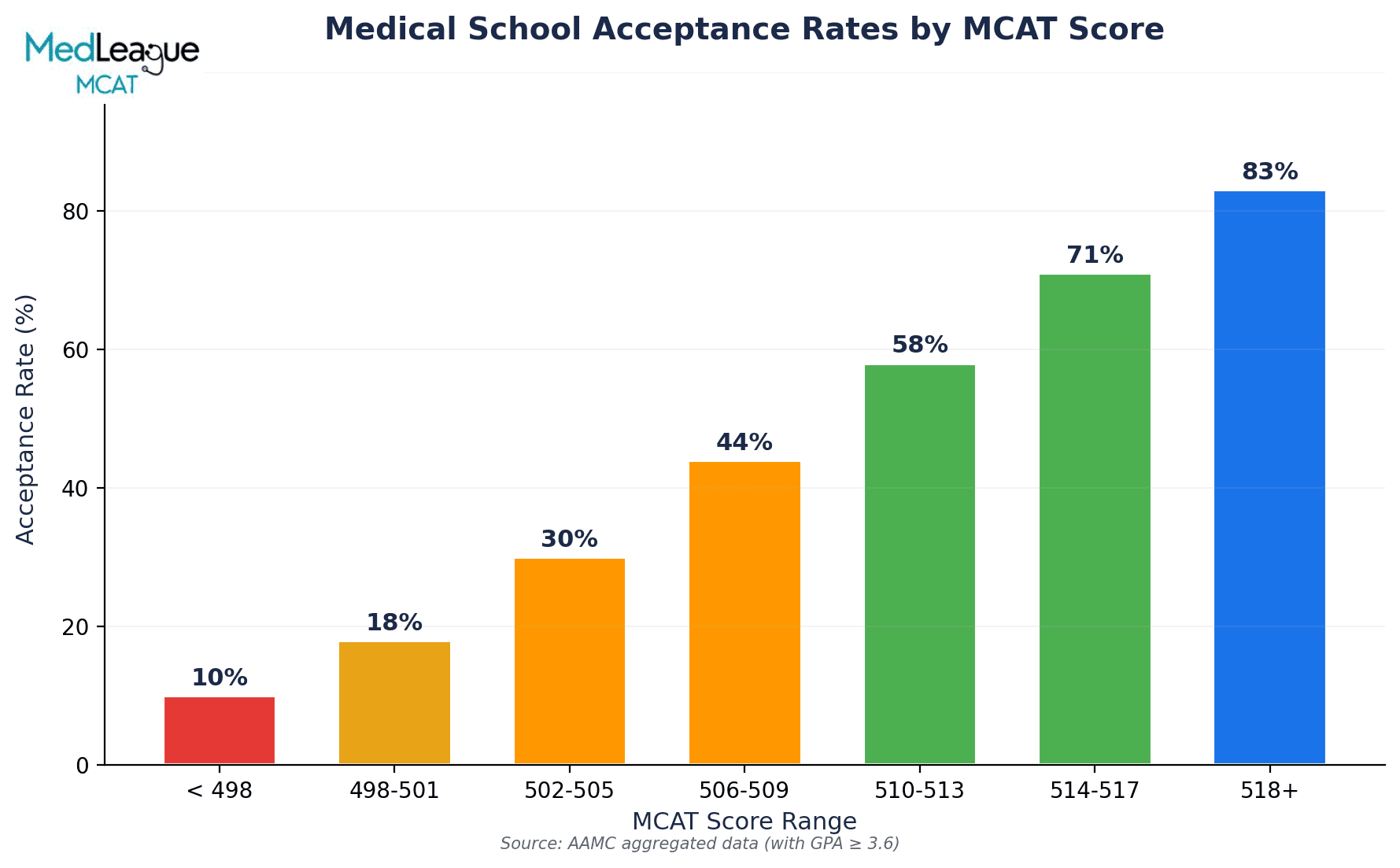
AAMC data shows that scoring 514 or above, combined with a strong GPA (3.6+), results in about a 71% acceptance rate. That's the inflection point where the odds tilt meaningfully in your favor.
How MCAT and GPA Work Together
Your MCAT score doesn't exist in a vacuum. Admissions committees look at it alongside your GPA, and the two can compensate for each other to a degree.
If your GPA is strong (3.7+), you have more flexibility on the MCAT. A 509-511 paired with excellent grades is still competitive at many programs.
If your GPA is on the lower side (3.4-3.6), you need a higher MCAT to compensate. A 514+ shows admissions committees that you have the academic ability even if your transcript has some rough patches.
If both are low, you're in a tough spot for MD programs. Consider DO programs (which tend to weigh the full applicant more holistically), post-bac programs to strengthen your GPA, or retaking the MCAT with structured prep.
Section Scores Matter Too
A total score of 512 could come from balanced section scores (128/128/128/128) or unbalanced ones (132/125/130/125). Admissions committees prefer balance. Some schools explicitly screen for section scores and may flag applications with any section below 125 or below 126.
The four sections have slightly different scoring distributions. Psych/Soc tends to have the highest average (125.9), while CARS has the lowest (124.6) and is widely considered the hardest section to improve on. A 128 in CARS is more impressive than a 128 in Psych/Soc because fewer test-takers reach that level.
If you have one section dragging your score down, targeted prep for that section can be more efficient than trying to raise your total score across the board.
What MedLeague Prep Costs vs. What a Retake Costs
If your score isn't where it needs to be, the question becomes whether to retake. Retaking costs $340 in AAMC registration fees alone, plus months of additional study time, and the stress of testing again. Many admissions committees look at all MCAT attempts, so a retake only helps if you improve significantly (3+ points minimum to justify it).
Structured prep dramatically increases the odds of a meaningful improvement. MedLeague students average a 17+ point score increase, turning borderline scores into competitive ones. At $1,700 with lifetime access, it's also significantly less than competitors like Kaplan ($2,299), Princeton Review ($2,399), or Blueprint ($2,299). All of those have limited access windows of 9-12 months; MedLeague's access is lifetime.
| Feature | MedLeague | Kaplan | Princeton Review | Blueprint |
|---|---|---|---|---|
| Price | $1,700 | $2,299 | $2,399 | $2,299 |
| Live Workshops | Unlimited | 42 hours | 123 hours | 40+ hours |
| Access Length | Lifetime | 9 months | 12 months | 12 months |
| Instructor Score | 99th %ile | 90th %ile | Not required | 85th %ile |
| AAMC Materials | Included | Included | Included | Included |
Building a Study Plan Around Your Target Score
If you know your target score, you can work backward to figure out what each section needs to look like. Divide your target by four to get a rough section target, then adjust based on your strengths and weaknesses.
For example, if you're targeting a 512, that's an average of 128 per section. But maybe your Psych/Soc is already strong (practice scores around 129-130) and CARS is weaker (around 125-126). In that case, your study plan should allocate more time to CARS strategy and passage practice.
We've put together a free 6-Month MCAT Study Plan that provides a week-by-week structure for content review, practice tests, and targeted practice. It's a solid starting point for building your personalized approach.
Real Student Results
Score improvement is real and measurable. Here are a few MedLeague students who moved from below-average to competitive:
Lindsey Baker went from a 488 to a 512, a 24-point improvement. She's now at Ohio University Medical School. Charlie Steweard improved from 492 to 515 and is at the University of Toledo Medical School. Kita Rao went from 505 to 517 and is at Austin Medical School.
These aren't outliers. They're representative of what happens when students combine consistent effort with structured, expert-guided preparation.
Next Steps
If you've already taken the MCAT and want to understand where your specific score falls, check out our score-by-score breakdown that covers every range from below 500 to 520+. If you're still in the planning phase, our guide on how to interpret your MCAT percentile will help you read your score report with confidence.
For a personalized strategy session where a 99th percentile MCAT expert evaluates your score, your school list, and your timeline, visit themedleague.com. You'll also get a free AAMC Full Length Exam ($40 value).