
Free Daily Practice
MCAT Psych/Soc Question of the Day
A brand-new Psych/Soc passage covering psychology, sociology, and biology, with questions and full explanations, every single day.
Passage
Weber's theory of social stratification emphasizes the multidimensional nature of inequality, encompassing class, status, and power. Bourdieu (1986) extended this framework by introducing the concept of capital conversion across generations.
A longitudinal study examined intergenerational income mobility patterns among 2,847 families tracked over 40 years. Initial data collection occurred in 1980 when primary earners were aged 25-34. Their adult children (n = 4,192) were surveyed between 2015-2020 when they reached ages 30-35. Participants were recruited from five metropolitan areas through stratified random sampling based on 1980 census tract income distributions.
Parental income quintiles were established using 1980-1985 average household earnings adjusted for inflation. Adult children's quintiles were calculated from 2015-2020 earnings data. Educational attainment, occupational prestige scores (Nakao-Treas scale), and self-reported class identification were collected for both generations. 316 participants were excluded due to incomplete income records.
The transition probability matrix revealed limited vertical mobility between generations. Children from the lowest parental income quintile had a 42.3% probability of remaining in that quintile as adults, while those from the highest quintile showed 39.7% persistence. Middle quintiles demonstrated greater fluidity, with transition probabilities ranging from 18.2% to 26.4% for adjacent quintiles.
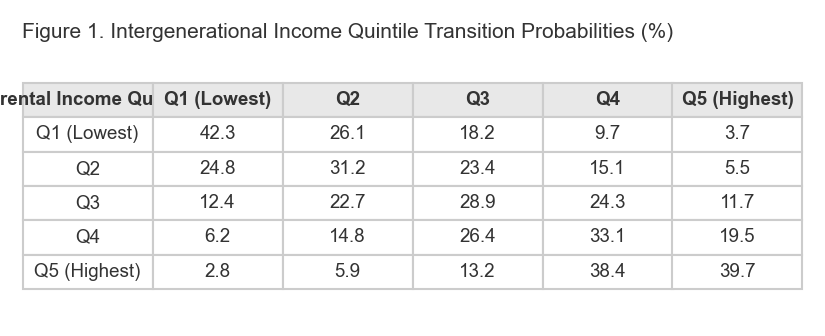
Figure 1 displays the quintile transition patterns. Diagonal clustering indicates substantial reproduction of parental income positions. Chi-square analysis confirmed non-random distribution of adult children across quintiles based on parental position (χ² = 892.41, df = 16, p < .001).
Educational attainment partially mediated the relationship between parental and child income quintiles. Path analysis revealed that parental income predicted years of education (β = .34, p < .001), which subsequently predicted adult child income quintile placement (β = .41, p < .001). The direct effect of parental income remained significant after controlling for education (β = .28, p < .001).
Class consciousness measures showed divergence between objective position and subjective identification. Among those in the lowest income quintile, 61.4% identified as "working class," while 23.8% selected "middle class." This pattern was most pronounced among those with post-secondary education but low earnings.
The findings suggest that despite meritocratic ideals, parental economic position substantially constrains offspring mobility opportunities. Bourdieu's concept of capital transmission appears relevant, as advantages extend beyond direct financial transfers to include educational access and occupational networks.
Sign up to see the questions
Enter your email to access today's Psych/Soc questions and get a new passage delivered to your inbox every day.
No spam. Unsubscribe anytime.
Want to crush Psych/Soc on the real MCAT?
MedLeague MCAT Prep includes unlimited live workshops, AAMC materials, and 99th percentile instructors. Students improve 17+ points on average.
Explore MCAT PrepHow It Works
Read the Passage
Each day features a new Psych/Soc passage covering psychology, sociology, and biology.
Answer the Questions
Test yourself on the questions. Select your answer, then check if you got it right.
Review Explanations
Read detailed explanations for every question. Understand not just the right answer, but why the others are wrong.
Frequently Asked Questions
Is this really free?▼
Yes. A new Psych/Soc passage with questions and explanations is published every day. All you need is an email address to access the questions.
When does the new passage appear?▼
A fresh passage goes live every day at midnight Eastern Time. Come back each day for new content.
Can I get the passages emailed to me?▼
Yes! When you sign up, we'll email you each day's Psych/Soc passage with the questions and answers so you can practice from your inbox.
Are these real AAMC-style questions?▼
Our passages and questions are written and reviewed to match the style, length, and difficulty of real MCAT Psych/Soc content.
How can I get more practice?▼
Daily practice is a great start. MedLeague MCAT Prep gives you unlimited live workshops from 99th percentile instructors, AAMC materials, and lifetime access. Students improve 17+ points on average.